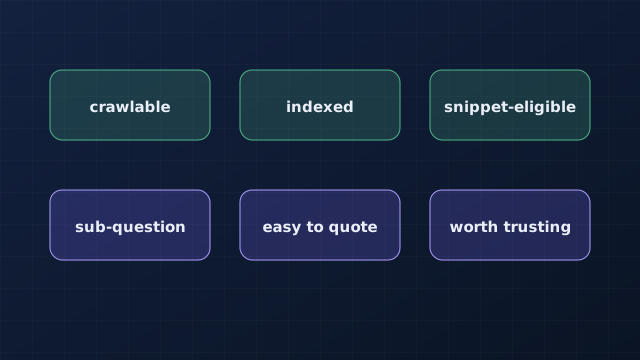
To be cited in an AI answer, a page must first be crawlable, indexed and allowed to appear, meaning snippets are not blocked and the site has not been excluded from Google's AI features. Those are the only documented requirements. After that, the page has to cover the question, state the answer plainly with specific, checkable facts, and be worth trusting. No markup, file or trick forces a citation, and nothing guarantees one. This guide separates what is documented from what is only suggested.
What is documented, what is studied, and what is untested
Most advice about "optimising for AI" mixes three very different levels of evidence. Google's documentation for AI features says a page must be indexed and eligible to show with a snippet, that there are no additional technical requirements, and that no special structured data, AI text file or machine-readable file is needed. Its guide to optimising for generative AI features goes further: ordinary SEO remains the foundation, and tactics such as chunking content, rewriting it "for AI" or chasing inauthentic mentions are not needed. Everything beyond that is either research or opinion, so label it as such before you spend time on it.
| Practice | Evidence level | What the evidence says |
|---|---|---|
| Let search crawlers fetch the page | Documented | Google: allow crawling in robots.txt and by any CDN or host. Each assistant's own docs name its search crawler: see AI crawlers and robots.txt |
| Be indexed and snippet-eligible | Documented | Google: a page must be indexed and eligible to show with a snippet to be a supporting link |
| Keep the site included in AI features | Documented | Google's Search generative AI setting in Search Console is Include by default. Excluding the site removes its links and content from AI Overviews and AI Mode |
| Keep important content as text | Documented | Google's best-practice list says important content should be available in text form |
| Structured data that matches the page | Documented, optional | Google: it should match visible text, and no special schema.org markup is needed for AI features |
| Cover the related sub-questions | Documented behaviour, our tactic | Google says AI features may run several related searches across subtopics (query fan-out). Covering follow-up questions is our inference |
| Add statistics, quotations and cited sources | Studied | The GEO paper reports visibility gains of up to 40% on its benchmark, varying by domain. It is a benchmark, not a live guarantee, and Google tells site owners to weigh third-party "GEO" advice against its own guidance |
| Be genuinely mentioned on third-party sites | Correlation only | Ahrefs' analysis of AI prompts finds mentions on platforms such as Reddit among the strongest correlates of AI brand mentions. Correlation is not proof it causes them, and Google says seeking inauthentic mentions is not useful |
| llms.txt and other "AI files" | Not used by Google Search | Google says these files don't affect Search visibility. The vendor documentation we read for this guide does not describe relying on one |
| Chunking or rewriting content "for AI" | Not required | Google says it is not needed: there is no ideal page length, and its systems understand synonyms and intent |
| Hidden text, hidden instructions for models, mass AI pages | Risky | Hidden text and scaled low-value pages are named in Google's spam policies, which say violating sites may rank lower or not appear. Hidden instructions aimed at models have no documented benefit |
- Spend your first hours on the gates: a page that can't be crawled or indexed can't be cited, however well it is written.
- Treat the studied and correlated items as experiments to test, using the baseline from your AI visibility audit, not as proven levers.
- Skip anything sold as an "AI file" or special markup to get cited. Google says it is not needed.
Pass the gates first
These are quick to test, and each failure is a hard stop. The three-gate picture above counts the last two together as "eligible to appear".
- Crawlable. Fetch your robots.txt and confirm the pages you want cited are not disallowed for Googlebot or for each assistant's search crawler. Check that your CDN or firewall isn't blocking those bots by their user agent either. The technical SEO audit walks through the checks.
- Indexed. In Search Console's URL Inspection, confirm the page is indexed. "Crawled, currently not indexed" and "Discovered" are not indexed.
- Snippet-eligible. Search the page source for
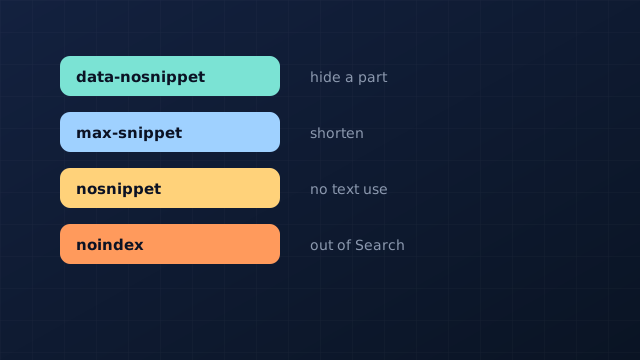
nosnippetanddata-nosnippet. Google saysnosnippetkeeps a page's content from being used as direct input for AI Overviews and AI Mode, so a leftover tag removes you from consideration. Google AI Overviews and AI Mode: how to control them and report on them covers each control. - Included. In Search Console, open Settings and check that Search generative AI is set to Include, on the property that covers this page. If it is set to Exclude, no page of the site can appear in AI Overviews or AI Mode.
Step 4 to 6: make the page worth quoting
This is the content layer. Nothing below is guaranteed to earn a citation, but each item removes a reason for an answer to skip your page.
- Open with the answer. Put a direct, self-contained answer in the first sentences under a heading that is the question itself. An answer that needs surrounding context is hard to lift cleanly.
- Be specific and checkable. Prices, ranges, timeframes, regions, versions and dates beat adjectives. If a figure comes from elsewhere, say where.
- Add what only you have. Your own prices, process, measurements, photographs or customer outcomes are the content no competitor can copy. Google's people-first content guidance asks the same: original information, and clear signs of who wrote it and why they are qualified.
- Cover the follow-ups. Because AI features may search related subtopics, answer the next two or three questions a reader would ask on the same page or on a clearly linked one.
- Use a table where the question compares things. Rows and columns are easy to read and easy to quote accurately.
- Show author and date. A visible byline, role and last-updated date let a reader judge the source.
- The question as the heading. It matches how people ask, and it tells a reader and a machine what the section answers.
- The answer in the first sentence. A price range and what it includes can be lifted without the paragraph around it.
- A table for the comparison. Each row stands alone and is easy to quote accurately.
- Who wrote it, and when. A named, qualified author and an updated date support trust.
- Where the numbers come from. A checkable origin separates original information from repetition.
The page checklist
- The page is not disallowed in robots.txt, and your CDN does not block search bots.
- URL Inspection shows the page is indexed.
- No
nosnippetor straydata-nosnippethides the content you want used. - Search Console's Search generative AI setting is on Include for this site.
- The main content is in the HTML as text, not only in images, scripts or downloads.
- The heading is the customer's question or need, in their words.
- The first sentences under it answer directly and stand alone.
- Every number has a unit, a date or a named source.
- The page holds something original: your data, process, prices or experience.
- The two or three likely follow-up questions are answered or clearly linked.
- A table is used where the question compares options.
- Author, role and last-updated date are visible.
- Any structured data matches what is visible on the page.
- Internal links from related pages use descriptive anchors, so the page is easy to find.
What not to do
- Don't hide text or instructions for AI. Google's spam policies name hidden text, such as text coloured to match the background or positioned off-screen, and say violating sites may rank lower or not appear at all. Instructions hidden for AI models have no documented benefit and carry the same risk.
- Don't mass-produce pages. Google's guidance on generative AI content says AI can help research a topic and structure original content, but generating many pages without adding value for users may violate its scaled content abuse policy. It also tells you to fact-check anything an AI writes before publishing.
- Don't fake third-party signals. Bought reviews, planted discussion posts and invented citations break platform rules and damage trust, which is what an assistant is trying to judge.
- Don't promise clients a citation. Google states that meeting every requirement does not guarantee a page is crawled, indexed or served.
Test one change at a time, and measure it properly
Pick the five questions where your baseline audit shows the weakest citation rate. Improve the one page that should answer each, using the checklist, and note the date. Re-run the same questions weekly and compare the ranges, not single answers. If the ranges separate, you have evidence. If they overlap, collect more answers before concluding anything. The same pages usually help classic rankings too: see how to improve Google rankings for prioritising the work.
Quick answers
Can anyone guarantee a citation in ChatGPT, Perplexity or AI Overviews?
No. Google says even pages that meet every requirement may not be crawled, indexed or served, and we found no vendor documentation describing a way to force a citation. Be wary of anyone selling one.
Do I need special schema or an llms.txt file to be cited?
Not for Google. It says no special structured data is needed for its AI features and that llms.txt files don't affect Search. Structured data is still worth using for rich results, as long as it matches the visible page.
Does blocking GPTBot stop ChatGPT citing my pages?
GPTBot is OpenAI's training crawler. OpenAI says OAI-SearchBot decides whether a site appears in ChatGPT search, so check that one first. AI crawlers and robots.txt lists each bot.
How long before changes show up in AI answers?
There is no documented timescale. Vendors say crawler changes can take about a day, and answers vary from run to run, so judge a change over several weeks of repeated checks, not one answer.
Sources and methodology
- Google Search Central: AI features and your website, for eligibility, query fan-out, the best-practice list and the statement that no special markup or files are needed.
- Google Search Central: Optimizing your website for generative AI features, for what Google says is and is not needed, including llms.txt, chunking and inauthentic mentions.
- Search Console Help: Search generative AI control, for the include and exclude setting.
- Google Search Central: Robots meta tag and X-Robots-Tag, for what
nosnippetdoes to AI features. - Google Search Central: Creating helpful, reliable, people-first content, for originality and authorship.
- Google Search Central: Spam policies and guidance on generative AI content, for what to avoid.
- Aggarwal et al., GEO: Generative Engine Optimization (KDD 2024), for the reported visibility gains of up to 40% on the GEO-bench benchmark, varying by domain. We read the abstract, not the full results.
- Ahrefs: which types of mentions correlate with AI visibility, for the third-party mention correlation. It is an industry analysis, and correlation is not causation.
Methodology. Google's statements were read on its documentation and Search Console help pages on 7 November 2026. The three-gates-and-three-qualities structure, the checklist and the evidence-level labels are our own framework, not a Google or industry standard. The example page is invented, with invented figures. No claim here is based on a test we ran on live AI assistants.
Reviewed .